Top 20 Influencer Marketing Tools for Brands and marketing agencies (2025)

 27 Nov

 10 min

 Heepsy Team

Top Influencer Marketing Platforms

Influencer marketing in 2025 has become the foundation of digital commerce. Brands across the U.S. are moving beyond follower counts to focus on measurable ROI, UGC creation, and AI-driven influencer discovery. The most successful platforms now enable brands and influencer marketing agencies to find influencers using advanced filters, follower engagement, creator authenticity and detailed reporting, turning creator collaborations into tracked sales funnels.

This guide highlights the top influencer marketing tools for 2025, comparing features, pricing, and best use cases. Whether you're a DTC brand looking for UGC at scale or an enterprise running multi-market activations, a marketing agency looking to drive results for clients using influencer marketing, this list shows which tools deliver real results — and which add noise.

The influencer tech stack of 2025 is all about creator authenticity, follower engagement, automation, attribution, costs and ease of influencer management — with Heepsy leading as the most intuitive and performance-driven platform for growing U.S. brands.

Introduction: The 2025 Influencer Marketing Landscape

In 2025, influencer marketing isn't just about brand awareness — it's a commerce channel. As social platforms like TikTok, Instagram, and YouTube evolve into shopping ecosystems, the influencer industry is shifting toward conversion-led partnerships.

Marketers now measure success in sales per creator, not likes per post. That's why influencer marketing platforms are no longer just databases of creators — they're operating systems for managing discovery, contracts, content, payments, and analytics.

Three trends define this year's influencer-tech landscape:

  1. Influencer Discovery & Authenticity Scoring – Tools now analyze millions of profiles to detect fake followers, engagement spikes, and audience fit.
  2. Commerce Integration – Platforms like Heepsy and Modash integrate with Shopify, Amazon, and WooCommerce to connect influencer posts directly to sales.
  3. Automation & ROI Measurement – Campaign management and payments are fully automated, allowing marketers to manage hundreds of creators with real-time performance tracking.
  4. Finding Real influencers – Heepsy provides tools to easily find Instagram influencers or TikTok influencers with real engagement and followers.

The result? Brands that unify influencer management and attribution under one roof are achieving faster growth, lower CAC, and scalable content production.

Quick Comparison Table – Top Influencer Marketing Platforms (2025)

PlatformBest ForStarting Price (USD)Channels
HeepsySMBs, DTC, and agencies needing fast influencer discovery and real ROI trackingFrom $69/moInstagram, TikTok, YouTube
HypeAuditorData-rich audience authenticity and fraud detectionFrom $399/moInstagram, TikTok, YouTube, X
UpfluenceE-commerce and affiliate marketing automationFrom $478/moInstagram, TikTok, YouTube, Twitch, X
ModashShopify-based influencer and affiliate trackingFrom $199/moInstagram, TikTok, YouTube
InfluencityFull-stack CRM and campaign analytics for agenciesFrom $168/moInstagram, YouTube, TikTok
GrinEstablished e-commerce brands and influencer-CRM integrationsFrom $2500/moInstagram, TikTok, YouTube
CreatorIQEnterprise influencer data and cross-market activationsFrom $35,000/yearAll major channels
KlearInfluencer relationship management and team collaborationFrom $33,100/yearInstagram, TikTok, YouTube, Twitter
Aspire (AspireIQ)DTC and lifestyle brands managing UGC and affiliate campaignsFrom $2,000/moInstagram, TikTok, YouTube
TraackrEnterprise influencer benchmarking and spend optimizationFrom $32,500/yearInstagram, YouTube, TikTok
CollabstrSMBs seeking fast UGC and pay-per-creator dealsFree to browseInstagram, TikTok, YouTube
Tagger (Sprout Social)Enterprise influencer analytics + social integrationFrom $199/moInstagram, YouTube, TikTok, X
Brandwatch InfluenceEnterprise social intelligence + influencer insightsFrom $800/moInstagram, TikTok, YouTube, X
Later InfluenceSMB and mid-market influencer workflows + schedulingFrom $400/moInstagram, TikTok
LinqiaFully managed influencer campaigns for enterprise brandsFrom $500/moInstagram, TikTok, YouTube
AfluencerSMBs looking for easy influencer matching & marketplace dealsFrom $49/moInstagram, TikTok, YouTube
Influencer.coMarketplace for influencers and brand collaborationsFree with paid upgradesInstagram, YouTube
Creator.coCommunity-driven influencer campaigns + micro influencersFrom $460/moInstagram, TikTok, YouTube
EmplifiEnterprise social marketing + influencer managementFrom $2,000/moInstagram, TikTok, YouTube, Facebook
AinfluencerMarketplace for SMBs needing quick influencer dealsFree to startInstagram, TikTok

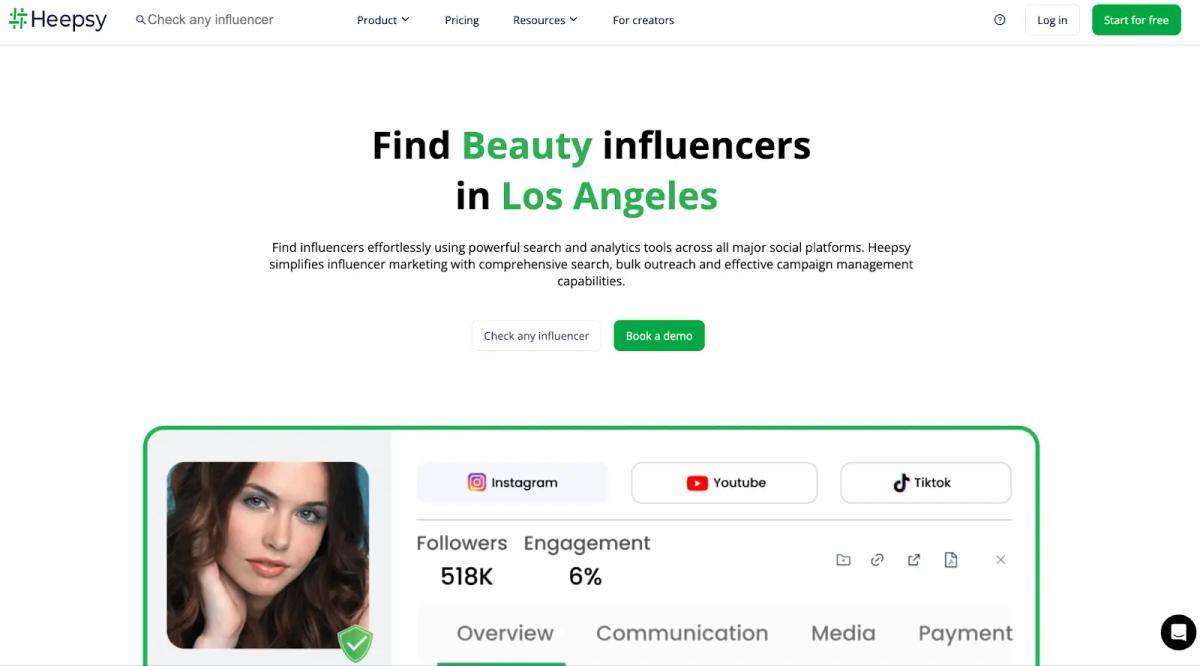
Heepsy

Best for: Mid to large Brands, E-Commerce companies, agencies, and DTC businesses that want fast influencer discovery and affordable pricing, measurable campaigns.

Pricing: Plans start from $69/month. Free trial available. Channels: Instagram, TikTok, YouTube

Why it Stands Out: Heepsy is one of the most accessible yet data-rich influencer marketing platforms in 2025. Designed for marketers who prioritize speed, accuracy, and verified ROI, it helps brands discover real creators, analyze audiences, and measure sales impact — all from one dashboard.

Heepsy dashboard

Heepsy is an influencer marketing platform built for businesses, agencies, SaaS companies, ecommerce brands, startups, and enterprise teams that need accurate and reliable influencer data. It provides niche filtering, detailed audience demographics, engagement analytics, authenticity scoring, and pricing benchmarks that help brands evaluate creators and compare influencer platforms effectively.

The platform is designed to support micro-influencer discovery, long-term partnerships, and cross-channel campaigns across Instagram, TikTok, and YouTube. With comprehensive data, an intuitive interface, and a lower barrier to entry than enterprise-level tools, Heepsy is positioned as one of the most useful and accessible influencer marketing platforms for small businesses and growing brands.

Heepsy simplifies influencer marketing for brands that need real results fast. With over 11 million creator profiles, built-in audience authenticity analysis, and integrations with Shopify and TikTok Shop, it bridges discovery and performance tracking better than any platform in its price range.

Heepsy vs. HypeAuditor: Heepsy is faster and easier for SMBs focused on campaign execution, while HypeAuditor offers deeper analytics for enterprise-level fraud detection.

Heepsy supports influencer search and analytics for Instagram, TikTok, and YouTube, making it suitable for multi-platform campaigns. It is best suited for small businesses, DTC brands, ecommerce companies, SaaS teams, and agencies that need a scalable and data-driven solution.

The platform offers built-in authenticity analysis, micro-influencer discovery, audience credibility scoring, and brand-safety checks. It includes pricing benchmarks to help estimate budget requirements and campaign costs. Heepsy works well for brands that want an unbiased, data-driven way to compare influencer marketing platforms across industries and use cases.

Key Features

1. Advanced Influencer Discovery

Heepsy's database spans over 11M+ influencers across Instagram, TikTok, and YouTube. Marketers can filter by location, engagement rate, niche, follower count, or brand affinity — ideal for identifying creators with genuine audiences in the U.S.

Highlight: Heepsy's built in features can filter influencers with fake followers or abnormal engagement, giving brands a shortlist of authentic, high-performing partners.

2. Audience Analytics & Authenticity Scoring

Each influencer profile includes data on:

  • Audience gender, age, and location breakdowns
  • Engagement rate benchmarks
  • Fake follower detection
  • Content type and posting frequency

This transparency helps influencer marketing teams to ensure brand-fit collaborations — avoiding wasted spend on low-quality accounts.

3. Campaign Management & Reporting

Heepsy's campaign tracking tools allow teams to manage outreach, collect influencer posts, and analyze performance in one place. Marketers can:

  • Track engagement, reach, and impressions per post
  • Monitor campaign ROI via UTM tracking
  • Export automated reports for stakeholders or clients

This workflow replaces spreadsheets entirely and is particularly valuable for agencies managing multiple campaigns.

4. Integrated E-commerce Attribution

Heepsy connects directly to Shopify, Amazon, and TikTok Shop, enabling real-time tracking of influencer-driven conversions. Marketers can see exactly how each creator contributes to clicks, sales, and average order value.

This data-first approach has made Heepsy a popular choice for DTC brands to scale creator partnerships into sales channels.

5. Collaboration Tools & Payments

Heepsy includes CRM-style collaboration tools for organizing influencer outreach, managing contracts, and approving content. You can message creators directly, track communication history, and store creative briefs — all within one workspace.

Proof of Performance

Heepsy has been used by 10,000+ brands globally, including top E-commerce brands, lifestyle brands and influencer marketing agencies.

In the U.S. market:

  • E-commerce brands report up to 3.8× ROI from tracked influencer campaigns.
  • Agencies cut influencer sourcing time by 60% compared to manual methods.
  • Retail brands leverage Shopify attribution to link creator activity directly to online revenue.

“We replaced spreadsheets and DMs with Heepsy’s dashboard. Our influencer campaigns now tie directly to tracked sales — not just vanity metrics.” — U.S. DTC Marketing Director, Lifestyle Brand

Pros & Cons

ProsCons
✅ Affordable for SMBs and agencies❌ Limited integrations beyond e-commerce platforms
✅ 11M+ authentic influencer profiles❌ Advanced analytics require mid-tier plans
✅ AI-powered fake follower detection❌ No built-in influencer payment processor
✅ Real ROI tracking for Shopify and TikTok
✅ Fast onboarding and intuitive UI

Heepsy vs. Other Platforms (2025)

Heepsy vs. HypeAuditor: Heepsy is faster for small and mid-size teams; HypeAuditor goes deeper on data analytics.

Heepsy vs. Upfluence: Upfluence offers end-to-end affiliate management; Heepsy focuses on streamlined discovery and ROI clarity.

Heepsy vs. Modash: Modash has stronger product seeding; Heepsy wins on ease of use and affordability.

Why Heepsy Leads in 2025

Heepsy strikes the perfect balance between affordability, authenticity, and attribution. It's simple enough for growing brands but powerful enough for serious marketers — making it the most accessible on-ramp to data-driven influencer marketing in 2025.

HypeAuditor

Best for: Data-driven marketers and agencies focused on authenticity, fraud detection, and competitive insights.

Pricing: Starting from $399/month Channels: Instagram, TikTok, YouTube, and X (Twitter)

Why It Stands Out: HypeAuditor is widely recognized as one of the most data-accurate influencer marketing analytics platforms in 2025. While Heepsy focuses on fast discovery and campaign execution, HypeAuditor digs deeper into audience authenticity, engagement quality, and brand safety — making it the go-to platform for enterprise and agency users who need verified data before committing budgets.

HypeAuditor dashboard

HypeAuditor is the analytics powerhouse of influencer marketing. It tracks more than 100 million influencers, performs AI-based fraud detection, and gives brands unmatched transparency into audience behavior. Its data integrity and benchmarking tools make it essential for U.S. enterprises and agencies managing large-scale campaigns or regulated industries.

HypeAuditor vs. Heepsy (2025): Heepsy offers quicker activation and lower cost for SMBs; HypeAuditor wins in analytical depth, compliance-grade insights, and competitive benchmarking.

Key Features

1. Advanced AI Fraud Detection

HypeAuditor's AI system evaluates every influencer's profile for fake followers, engagement pods, suspicious activity, and inorganic spikes in performance. Each creator receives a "Trust Score" that predicts authenticity — a crucial metric for brands in regulated industries like finance, healthcare, or CPG.

📊 Insight: 46% of brands surveyed in 2025 cited "authenticity" as their #1 KPI when choosing influencer partners.

2. Deep Audience Analytics

Marketers can analyze influencers by:

  • Demographics (age, gender, location)
  • Audience interests and brand affinity
  • Language distribution and sentiment tone
  • Device type and behavioral metrics

HypeAuditor's Audience Overlap Tool helps brands avoid duplication — ensuring campaigns don't waste spends targeting the same followers through multiple influencers.

3. Competitive Benchmarking

A defining feature of HypeAuditor is its competitor tracking engine. You can analyze rival brands' influencer networks, track their engagement benchmarks, and identify creators driving success for your competition.

This intelligence helps you reverse-engineer winning influencer strategies — a key differentiator for U.S. agencies managing multi-brand portfolios.

4. Campaign Tracking & Reporting

HypeAuditor integrates real-time performance tracking across Instagram, TikTok, YouTube, and X.

Dashboards visualize:

  • Engagement rate per creator
  • Audience reach and impressions
  • Sentiment breakdown (positive, neutral, negative)
  • Cost-per-engagement (CPE) and ROI metrics

Automated reports are exportable in white-label format — ideal for agency clients and brand stakeholders.

5. Influencer Discovery and Lookalike Search

With a database of over 100M influencers, HypeAuditor's AI engine can surface new creators based on lookalike audiences from your best-performing partnerships. It's particularly strong for finding niche creators in sectors like tech, finance, beauty, or wellness.

Proof of Performance

HypeAuditor powers influencer campaigns for some of the largest global and U.S. brands,

Results include:

  • 78% faster vetting process compared to manual screening
  • 95% accuracy in fake follower detection
  • 32% cost savings for agencies that use HypeAuditor to eliminate underperforming creators

“We switched from manual audits to HypeAuditor and instantly improved campaign quality. The data clarity is unmatched.” — Head of Social Strategy, Fortune 500 Beauty Brand

Pros & Cons

ProsCons
✅ Industry-leading authenticity scoring❌ Pricier for small businesses
✅ 100M+ influencer database❌ No direct influencer outreach tools
✅ Powerful competitive benchmarking❌ Lacks integrated e-commerce attribution
✅ Sentiment analysis and audience overlap tools❌ Can feel data-heavy for small teams
✅ White-label reporting for agencies

HypeAuditor vs. Other Platforms (2025)

HypeAuditor vs. Heepsy: Heepsy is faster and more affordable; HypeAuditor offers deeper authenticity verification and brand-safety analytics.

HypeAuditor vs. Upfluence: Upfluence emphasizes automation and payments, while HypeAuditor focuses on data reliability and campaign analysis.

HypeAuditor vs. Modash: Modash integrates Shopify for e-commerce; HypeAuditor excels in influencer vetting and fraud detection.

Why HypeAuditor Leads in 2025

In an age where fake followers and engagement pods still threaten ROI, HypeAuditor remains the most trusted verification tool for influencer marketing. Its blend of audience intelligence, fraud prevention, and benchmarking gives U.S. marketers the confidence to invest in creators who deliver genuine influence.

Upfluence

Best for: E-commerce and DTC brands that want to unify influencer marketing, affiliate programs, and automated payouts in one system.

Pricing: Custom plans starting at approximately $478/month Channels: Instagram, TikTok, YouTube, X, Twitch, Facebook

Why It Stands Out: Upfluence bridges the gap between influencer marketing and e-commerce. It's a full-funnel influencer and affiliate management suite designed for brands that measure success in sales, not impressions.

Its biggest advantage is how it connects influencer activity directly to Shopify, WooCommerce, Amazon, and other commerce platforms — turning every post into a trackable sales event.

Upfluence dashboard

Upfluence is an end-to-end influencer and affiliate marketing platform for U.S. brands that want measurable ROI. With 12M+ creators, AI-driven discovery, and integrated payments, it centralizes every part of influencer operations — from outreach to checkout.

Upfluence vs. Heepsy (2025): Heepsy is faster for influencer discovery and SMB teams; Upfluence dominates in affiliate integration, commerce attribution, and enterprise-level automation.

Key Features

1. Influencer Discovery

Upfluence's discovery engine analyzes over 12 million verified creators across Instagram, TikTok, YouTube, and Twitch. Brands can filter by audience demographics, engagement quality, keywords, and brand affinity.

A standout feature: it identifies influencers who already follow or purchase from your brand — often the most authentic and high-converting partners.

2. Affiliate & Promo Code Management

Upfluence is one of the few influencer platforms to natively manage affiliate programs. Marketers can generate unique promo codes for each influencer, compatible with Shopify, WooCommerce, Magento, and Amazon Attribution, and automatically track revenue from those codes.

This feature makes it ideal for U.S. e-commerce and DTC teams aiming to connect influencer content directly to purchase behavior.

3. Creator Relationship Management (CRM)

Inside its Creator Relationship Management system, users can coordinate:

  • Outreach and onboarding
  • Contracts and compliance
  • Content approvals and publication tracking

Automated workflows reduce repetitive manual tasks, letting teams scale influencer programs efficiently across multiple campaigns and product lines.

4. Payments and Product Gifting

With Upfluence Pay, brands can process global influencer and affiliate payouts with just one click. The platform automates commission calculations, manages tax forms, and supports payment methods such as PayPal, Stripe, or wire transfer in multiple currencies.

The product gifting feature also lets influencers select products, colors, and sizes directly from a synced e-commerce store — streamlining seeding campaigns for apparel, beauty, and lifestyle brands.

5. Real-Time ROI Tracking

Upfluence's analytics suite pulls live data from integrated storefronts, displaying:

  • Clicks, conversions, and revenue per creator
  • ROI by campaign or channel
  • Attribution by affiliate code or tracking link

For teams reporting to leadership or investors, this precision turns influencer marketing into a quantifiable revenue driver — not just an awareness channel.

Proof of Performance

Upfluence powers influencer programs for brands such as Marriott, ASICS, Yamaha, and HelloFresh.

Notable results include:

  • +350% increase in sales and 75% faster influencer discovery for The Atfluence Agency
  • 10× ROI for Amazon-integrated campaigns with Branded
  • $384K in tracked sales and 20× ROI for Nocibé Group

“Upfluence helped us prove influencer ROI to our board. We can now attribute every creator to dollars in the cart.” — VP of Marketing, U.S. Retail Brand

Pros & Cons

ProsCons
✅ 12M+ creator profiles across all major platforms❌ Pricing geared toward mid-market and enterprise users
✅ Integrated affiliate management and promo code tracking❌ Requires onboarding for new users
✅ One-click payouts and global gifting❌ Feature depth may overwhelm small teams
✅ Strong e-commerce integrations (Shopify, Amazon)
✅ Proven enterprise ROI

Upfluence vs. Other Platforms (2025)

Upfluence vs. Heepsy: Heepsy is faster and cheaper for discovery; Upfluence shines in end-to-end campaign management and commerce ROI tracking.

Upfluence vs. Modash: Modash is built primarily for Shopify-focused SMBs; Upfluence offers broader integrations and enterprise scalability.

Upfluence vs. Influencity: Influencity is stronger in CRM and analytics; Upfluence dominates affiliate and payment automation.

Why Upfluence Leads in 2025

Upfluence continues to set the standard for influencer + affiliate hybrid marketing. Its ability to connect social activity to real-world sales and automate tedious workflows makes it a cornerstone tool for high-growth e-commerce brands.

Modash

Best for: Shopify and eCommerce brands that want scalable influencer discovery, affiliate management, and real-time campaign tracking.

Pricing: 14-day free trial; paid plans start at $199/month Channels: Instagram, TikTok, YouTube

Why It Stands Out: Modash is purpose-built for eCommerce growth teams. It connects influencer discovery, product gifting, and affiliate tracking directly to your store. For U.S. DTC marketers using Shopify, WooCommerce, or Amazon, Modash acts as a plug-and-play performance engine — eliminating manual outreach, spreadsheets, and tracking chaos.

Modash dashboard

Modash empowers small to mid-sized eCommerce brands to scale influencer programs fast. Its Shopify-native integrations, automatic coupon tracking, and no-signup creator tracking make it a must-have for marketers who want measurable sales data without the complexity of enterprise suites.

Modash vs. Upfluence (2025): Modash is simpler, faster, and more affordable for Shopify stores, while Upfluence offers broader enterprise-level integrations and affiliate management depth.

Key Features

1. Creator Search & Authenticity Filters

Modash's AI-powered search engine scans millions of influencers on Instagram, TikTok, and YouTube, analyzing niche, audience location, and engagement.

Each profile displays:

  • Verified contact details
  • Authenticity and audience breakdowns
  • Past brand collaborations
  • Follower demographics

This helps marketers quickly identify creators who align with their target buyer persona and avoid fake or inactive profiles.

2. Shopify Integration

Modash's standout feature is its Shopify integration, which allows you to:

  • Send products directly from your store to influencers
  • Track coupon codes and referral links automatically
  • View conversion and sales metrics in real time

Influencers can promote products using unique discount codes, and brands can see exactly which creators are driving traffic and purchases.

3. Campaign Tracking & Attribution

Modash automates the monitoring of influencer content and campaign performance — even without influencer opt-in. It tracks every:

  • Post, story, and video view
  • Clicks and conversions
  • Engagement rate and ROI per campaign

Dashboards update in real time, giving teams instant visibility into their most profitable creators.

4. Bulk Outreach & Relationship Management

Modash includes automated email outreach and CRM-style management. You can:

  • Send personalized emails to hundreds of creators
  • Track responses and manage approvals
  • Tag and organize creators by campaign or niche

This makes it easy to scale micro- and nano-influencer programs across multiple products or seasonal launches.

5. Reporting & Analytics

Performance reports show ROI, total conversions, and sales per influencer. Data can be exported to share with teams or clients, simplifying reporting cycles.

📈 In 2025, brands using Modash report 3–5× faster campaign activation and a 40% higher engagement rate compared to manual influencer outreach.

Proof of Performance

Brands like BioTechUSA, Burga, and Regal Rose rely on Modash to automate influencer management.

Case highlights include:

  • BioTechUSA: Activated 70+ influencers and 500+ nano creators internationally.
  • Burga: Reported Modash as its #1 influencer tool across its marketing team.
  • Regal Rose: Eliminated manual tracking and achieved fully automated content monitoring.

“Modash replaced spreadsheets overnight. We now know exactly which creators sell — and which don't.” — CMO, U.S. DTC Apparel Brand

Pros & Cons

ProsCons
✅ Full Shopify integration with coupon tracking❌ Focused mainly on Shopify (limited for other CMS)
✅ No opt-in required for influencer tracking❌ Fewer creative briefing tools
✅ AI discovery and verified influencer data❌ Email outreach setup takes initial time
✅ Real-time ROI dashboard
✅ Affordable and scalable for SMBs

Modash vs. Other Platforms (2025 TL;DR)

Modash vs. Upfluence: Upfluence is ideal for enterprise programs; Modash is better for lean DTC teams on Shopify.

Modash vs. Heepsy: Heepsy excels in finding influencers and influencer outreach; Modash adds eCommerce attribution.

Modash vs. Influencity: Influencity offers CRM depth; Modash wins in real-time sales tracking and automation simplicity.

Why Modash Leads in 2025

Modash democratizes influencer marketing for online stores. Its Shopify integration, fast outreach, and automated ROI tracking give marketers the same power as enterprise teams — without the learning curve.

It's a great fit for the U.S. DTC brands that value simplicity, automation, and measurable results.

Influencity

Best for: Agencies and mid-to-large brands needing a complete influencer CRM to manage discovery, relationships, and analytics in one workspace.

Pricing: Free trial available; paid plans from $168 per month

Channels: Instagram, TikTok, YouTube

Why It Stands Out: Influencity is an all-in-one influencer operating system built for data-driven teams. It unifies discovery, relationship management, campaign execution, and analytics in a single dashboard—offering depth and flexibility rarely found outside enterprise suites.

For brands running multiple activations or agencies juggling dozens of clients, Influencity centralizes everything into one connected workflow.

Influencity dashboard

Influencity transforms influencer marketing from a creative experiment into a structured, data-driven discipline. With 200 million + profiles, built-in CRM, multi-campaign tracking, and fake-follower detection, it's a complete platform for brands that value accuracy, organization, and ROI.

Influencity vs. Modash (2025):

Modash wins for Shopify eCommerce integrations; Influencity is superior for multi-client management, analytics, and relationship governance.

Key Features

1. AI-Powered Influencer Search

Influencity's database includes over 200 million creators across Instagram, YouTube, and TikTok.

Search filters cover niche, audience demographics, location, engagement rate, and past brand collaborations.

An integrated fake-follower detector flags suspicious activity so marketers can focus on authentic voices.

2. Influencer Relationship Manager (IRM)

Think of this as a CRM built specifically for influencer workflows. You can:

  • Log emails, notes, and contract status for each creator.
  • Tag influencers by brand or campaign.
  • Assign team members to accounts and track touchpoints.
  • Create custom fields for budget status or deliverables.

For agencies managing multiple clients, this level of organization is a massive time saver.

3. Campaign Manager & Automated Reports

The Campaign Manager tool consolidates everything from briefs to results:

  • Set KPIs and budget limits.
  • Track content submission and publication status.
  • View engagement, reach, and conversion metrics in real time.
  • Export automated branded reports for clients or executives.

Each campaign report pulls data from platform APIs and Influencity's own database, producing highly accurate ROI visualizations.

4. Team Collaboration & Permissions

Influencity supports role-based access and multi-user workspaces. Teams can work simultaneously on different campaigns without data overlap—crucial for agencies or brands running localized activations across any location.

5. Integrations & Attribution

Integrates with Shopify, Google Analytics, and CRM tools to connect influencer efforts with sales and lead generation.

Marketers can assign unique tracking links to each creator and follow the entire funnel from post to purchase.

Proof of Performance

Influencity has been adopted by brands like PowderPeaks, Tropic Skincare, and L'Oréal Group. Reported outcomes include:

  • 77 % faster influencer search time (45 → 20 minutes per profile)
  • 260 % increase in qualified profiles per search
  • 70 % reduction in vetting time with AI-driven dashboards
  • 64 % response rate in seeding programs — twice the industry average

“Influencity gave our agency a 360-degree view of every campaign and client. We can literally see ROI in real time.” — Senior Campaign Manager, U.S. Agency Network

Pros & Cons

ProsCons
✅ 200 M + influencer database❌ Takes time to set up custom fields and dashboards
✅ Full-cycle campaign management❌ Interface can feel dense for new users
✅ CRM and team collaboration features❌ Requires training for smaller teams
✅ Multi-currency and Shopify integration
✅ Strong analytics and white-label reporting

Influencity vs. Other Platforms (2025)

Influencity vs. Modash: Influencity is better for relationship management and reporting; Modash is stronger in Shopify ROI automation.

Influencity vs. Heepsy: Heepsy is more suitable for finding influencers; Influencity adds multi-client control and advanced analytics.

Influencity vs. Upfluence: Upfluence integrates affiliate payments; Influencity provides a more granular CRM organization.

Why Influencity Leads in 2025

Influencity turns influencer marketing into a scalable CRM discipline. By bringing discovery, communication, and reporting under one roof, it empowers agencies and growing brands to run data-driven programs with precision.

For global influencer marketing teams balancing multiple markets and clients, it's the platform that keeps everything organized and measurable.

Grin

Best for: Established DTC and e-commerce brands that need a single system to manage influencer relationships, affiliate programs, product seeding, and performance ROI—directly tied to their online store.

Pricing: Custom; typical starting plans ≈ $2500 per month

Channels: Instagram · TikTok · YouTube · Facebook · Twitch

Why It Stands Out: Grin pioneered the creator-CRM model and remains a go-to for U.S. brands like Allbirds, SKIMS, Warby Parker, and MVMT that want to treat creators as long-term partners—not just campaign contractors. It plugs directly into your e-commerce stack (Shopify, BigCommerce, WooCommerce, Amazon Attribution) and tracks influencer-driven sales down to the SKU level.

Grin dashboard

Grin replaces spreadsheets with an influencer-relationship engine. Its native Shopify connection, affiliate-link automation, and payout workflows let marketing, finance, and logistics teams all work from one source of truth.

Grin vs Upfluence (2025 Quick Take): Grin wins on e-commerce attribution and simplicity; Upfluence offers deeper marketplace reach for global enterprises.

Key Features

1 Influencer Relationship Management (CRM)

Grin's CRM stores every creator touchpoint—emails, contracts, deliverables, and payment history—in a unified dashboard. Tags, filters, and pipelines visualize each partnership stage from outreach → collaboration → renewal.

Ideal for: Brands managing hundreds of micro- and mid-tier ambassadors who post repeatedly across product launches.

2 Product Seeding & Fulfillment

Grin syncs directly with your store catalog so teams can:

  • Ship gifted or discounted products with live inventory tracking.
  • Auto-populate influencer orders and shipping updates.
  • Generate personalized discount codes and affiliate links per creator.

This automation removes manual logistics while capturing post-purchase data.

3 Affiliate & Sales Attribution

Every influencer link and code is tracked to revenue. Dashboards show:

  • Total orders · Average Order Value · ROI by creator
  • Conversion funnel (click → cart → purchase)
  • Lifetime value of repeat customers from creator referrals

Finance teams can reconcile commissions instantly, improving payout accuracy.

4 Analytics & ROI Dashboards

Grin's analytics visualize engagement, reach, and conversions side-by-side with historical benchmarks. The system supports:

  • Multi-currency reporting for global campaigns
  • UTM-level tracking through Google Analytics
  • Exportable client or exec-ready PDF dashboards

5 Payments & Tax Automation

Grin automates end-to-end creator payments:

  • Bulk payouts via PayPal, ACH, or wire
  • Automatic W-9 collection and 1099 generation
  • Commission rules based on sales volume or content type

Proof of Performance

  • Allbirds: 4× faster campaign activation, $1 M tracked revenue in first year
  • SKIMS: Centralized 300 creator partners; cut manual reporting time by 60 %
  • MVMT: Drove 35 % YoY growth from affiliate sales through Grin's ROI tracking
  • Warby Parker: Unified UGC and affiliate teams under one dashboard

“Grin's Shopify integration gave us end-to-end visibility—from gifted product to repeat purchase.” — Director of Influencer Marketing, U.S. Apparel Brand

Pros & Cons

ProsCons
True creator-CRM replacing spreadsheetsPremium pricing for smaller brands
Direct Shopify integration with sales trackingSetup requires Shopify or comparable store
Automated affiliate links and paymentsLess flexibility for one-off campaigns
Built-in tax compliance & payout toolsMarketplace discovery is more limited than Heepsy or Modash
Strong analytics and exportable reports

Grin vs Other Platforms (2025)

Grin vs Heepsy: Heepsy leads in global influencer discovery; Grin dominates in e-commerce CRM and revenue tracking.

Grin vs Modash: Both excel with Shopify, but Grin adds affiliate payouts and tax automation.

Grin vs Influencity: Influencity is built for agencies; Grin is built for brand-side teams.

Why Grin Leads in 2025

In a landscape where creators function as full-funnel sales partners, Grin unites influencer CRM, affiliate marketing, and commerce attribution in one stack. For DTC brands seeking to tie every creator post to real revenue, Grin remains the benchmark.

CreatorIQ

Best for: Global enterprises, agencies, and Fortune 1000 brands managing large-scale influencer ecosystems with complex reporting and compliance needs.

Pricing: Enterprise-only (custom; typically starts at $2,000/month)

Channels: Instagram · TikTok · YouTube · Facebook · Twitch · Pinterest · X (Twitter)

Why It Stands Out: CreatorIQ is the enterprise backbone of influencer marketing, trusted by brands like Disney, Sephora, Unilever, and Airbnb. It's known for data governance, workflow automation, and integrated ROI attribution — connecting marketing, legal, and analytics teams within one secure infrastructure.

It's less a marketplace and more an influence intelligence platform — built to unify every part of the creator economy under measurable business outcomes.

CreatorIQ dashboard

CreatorIQ powers global influencer operations with advanced analytics, brand-safety scanning, and end-to-end API connectivity. It's ideal for large U.S. and global brands that require scale, security, and compliance alongside deep insights.

CreatorIQ vs. Grin (2025): Grin focuses on Shopify-native eCommerce attribution; CreatorIQ dominates when complexity, scale, and data precision matter most.

Key Features

1 · Enterprise-Grade Creator Database

CreatorIQ manages over 50 million influencer profiles, enriched with first-party data and social API connections. The platform automatically verifies followers, engagement rates, and content authenticity, while providing advanced filters by category, audience demographics, brand affinity, and conversion behavior.

Its proprietary IQ Score ranks creators by influence credibility — factoring audience quality, posting consistency, and sentiment data.

2 · Unified Influencer CRM & Workflows

CreatorIQ eliminates siloed campaign spreadsheets. Teams can:

  • Assign workflows by market, product line, or campaign type.
  • Manage contracts, briefs, and content approvals in one dashboard.
  • Track communication threads across all influencers globally.
  • Use role-based access to protect sensitive brand data.

Agencies can manage multiple clients without overlap, while brands can coordinate influencer programs across internal divisions (e.g., social, PR, paid media).

3 · Data & ROI Measurement

CreatorIQ integrates with tools like Google Analytics, Adobe Analytics, Salesforce, and Shopify to deliver full-funnel attribution. Dashboards visualize metrics like:

  • Content performance by creator, region, or campaign
  • Engagement, impressions, EMV, conversions, and sales
  • Cost-per-view and return on ad spend (ROAS)

Data can be exported into BI tools or pushed into existing marketing databases via API for cross-channel analysis.

4 · AI Insights & Brand Safety

The CreatorIQ Intelligence Layer uses AI to identify risky content, fake engagement, or negative sentiment trends before collaborations begin. It flags creators for profanity, political sensitivity, or historical controversies—protecting brands from reputational harm.

In 2025, the system also offers predictive performance modeling, forecasting campaign outcomes based on historical content behavior and audience resonance.

5 · Cross-Department Collaboration

CreatorIQ isn't just for influencer teams—it's designed for the entire marketing organization. Legal, finance, analytics, and creative teams can access the same campaign data, ensuring transparency and compliance.

Proof of Performance

  • Airbnb: 35% cost reduction in global influencer management time
  • Sephora: 4× faster campaign setup across 20 markets
  • Unilever: Unified influencer data across 400+ brands and reduced reporting cycles from weeks to hours
  • Disney: Integrated creator performance into paid media reporting for 3× faster ROI insights

“CreatorIQ is our single source of truth for all creator partnerships. It scales with our business.” — Director of Global Influencer Marketing, Fortune 500 Beauty Brand

Pros & Cons

ProsCons
✅ 50M+ verified profiles with IQ Score⚠️ Premium pricing for enterprise tier only
✅ Deep integrations with analytics & CRM tools⚠️ Complex setup for small teams
✅ Predictive performance & sentiment tracking⚠️ No self-serve trial
✅ Role-based access and governance⚠️ Steeper learning curve
✅ Robust compliance and data security

CreatorIQ vs. Other Platforms (2025)

CreatorIQ vs. Heepsy: Heepsy is lean and discovery-focused; CreatorIQ provides enterprise-level compliance, API depth, and analytics.

CreatorIQ vs. Upfluence: Upfluence blends marketplace access; CreatorIQ is stronger for multi-market data governance.

CreatorIQ vs. Brandwatch Influence: Brandwatch excels in analytics visualization; CreatorIQ leads in system integration and predictive modeling.

Why CreatorIQ Leads in 2025

CreatorIQ represents the enterprise gold standard in influencer marketing — combining AI discovery, analytics rigor, and security infrastructure. For U.S. Fortune 500 brands, it's not just software—it's the operating system for scaling influencer-led performance marketing safely and measurably.

Klear

Best for: Mid-to-enterprise brands and agencies that prioritize influencer relationship management, campaign analytics, and social listening in one integrated workspace.

Pricing: From $33,100/year; enterprise plans available

Channels: Instagram · TikTok · YouTube · X (Twitter) · Facebook · Blogs

Why It Stands Out: Klear bridges influencer discovery and PR analytics, helping U.S. brands manage every stage of influencer collaboration—from identification to campaign tracking—within a unified, data-backed environment.

It's especially strong for teams that want to combine earned media, influencer marketing, and social listening to see how influencer content contributes to broader brand reputation.

Klear unites influencer marketing with social intelligence. It allows brands to find, vet, and nurture creators, monitor campaign ROI, and even track sentiment around influencer-driven conversations—making it a perfect fit for marketers who treat influencer marketing as part of their holistic communications strategy.

Klear vs. CreatorIQ (2025 Quick Take): CreatorIQ focuses on enterprise data pipelines; Klear emphasizes usability, relationship depth, and real-time analytics for leaner teams.

Klear dashboard

Key Features

1 · Influencer Discovery and Vetting

Klear hosts over 30 million influencer profiles, each enriched with AI-generated audience demographics, authenticity metrics, and brand affinity data.

Advanced filters help U.S. marketers pinpoint influencers by:

  • Location, niche, follower tier
  • Audience interests and languages
  • Historical campaign content
  • Engagement and EMV (Earned Media Value)

A proprietary Klear Influence Score grades creators by reach, engagement, and trust—helping brands avoid vanity metrics and focus on ROI-driving creators.

2 · Influencer Relationship Management (IRM)

Klear's IRM replaces fragmented spreadsheets and DMs with a structured communication hub.

Features include:

  • Built-in messaging and email integration
  • Contract tracking and deliverables checklist
  • Collaboration notes and task assignment for teams

Teams can view a complete interaction history for each influencer, ensuring long-term relationships stay organized and measurable.

3 · Campaign Management and Reporting

Marketers can launch campaigns, approve content, and track performance from one interface.

Klear automatically aggregates:

  • Reach, impressions, engagement rate, and EMV
  • Audience growth and sentiment post-campaign
  • ROI dashboards linked to brand goals

Reports are exportable and ready for presentation—perfect for PR agencies and brand-side leadership reporting.

4 · Social Listening and Competitive Analysis

Where Klear really shines is in its integration with Meltwater's media intelligence tools. Teams can monitor how influencer content influences conversation volume, tone, and share of voice compared to competitors. This bridges performance marketing with brand reputation management—rare among influencer tools.

5 · Compliance and AI Insights

Klear supports FTC disclosure monitoring, brand-safety alerts, and AI-driven content scanning to flag controversial or high-risk posts before publication. The system also analyzes long-term engagement trends, enabling predictive performance forecasting.

Proof of Performance

BrandOutcome
Canon USAGrew engagement 160% by combining influencer + UGC tracking
AdidasReduced influencer management time by 45% while boosting post accuracy
Estee LauderConnected PR and influencer data for full-funnel brand awareness tracking
Hyundai USAIntegrated social listening with influencer campaigns for unified reporting

“Klear's data granularity gave us insight into both ROI and sentiment. It's the closest thing to a full influencer-PR platform.” — Head of Communications, U.S. Auto Brand

Pros & Cons

ProsCons
✅ Combines influencer marketing + PR analytics⚠️ Limited direct e-commerce attribution
✅ Built-in CRM for long-term creator relationships⚠️ Reporting customization requires enterprise plan
✅ AI-driven authenticity & brand-safety filters⚠️ Steeper learning curve for new Meltwater users
✅ Excellent social listening & sentiment tracking
✅ Integrates with Meltwater's media monitoring suite

Klear vs. Other Platforms (2025)

Klear vs. Heepsy: Heepsy is beneficial for medium size brands, marketing teams and creators; Klear adds deep analytics and PR integration.

Klear vs. Influencity: Influencity is stronger for campaign logistics; Klear leads in sentiment and reputation insights.

Klear vs. Aspire: Aspire focuses on UGC and brand-creator communities, while Klear offers corporate-grade reporting and media alignment.

Why Klear Leads in 2025

Klear merges influencer marketing and media intelligence into one strategic tool. For the influencer marketing teams balancing brand storytelling, reputation, and measurable ROI, it provides both breadth and depth—making it a key platform in the 2025 social commerce stack.

Aspire (formerly AspireIQ)

Best for: U.S. DTC brands and agencies running always-on creator communities, UGC programs, and affiliate partnerships within one unified platform.

Pricing: Custom; typical plans start around $2000/month

Channels: Instagram · TikTok · YouTube · Pinterest · Facebook

Why It Stands Out: Aspire has evolved into a community-driven influencer and UGC platform built for scalability. Trusted by global brands, Aspire connects influencer marketing, content creation, and affiliate programs under one roof. It's not just about finding influencers—it's about cultivating long-term brand ambassadors.

Aspire transforms influencer marketing into a community ecosystem. It excels in UGC production, affiliate tracking, and cross-channel analytics, making it perfect for U.S. marketers blending organic storytelling with performance ROI.

Aspire vs. Klear (2025 Quick Take): Klear focuses on analytics and PR integration; Aspire shines in creator relationships, workflow automation, and content reuse.

Aspire dashboard

Key Features

1 · Creator Discovery & Marketplace Access

Aspire's database includes 500K+ opt-in creators searchable by niche, demographics, content type, and engagement. The Creator Marketplace allows brands to post campaigns publicly so vetted creators can apply directly—reducing manual outreach.

Smart filters highlight creators who've worked with similar brands or generate high-performing UGC for paid amplification.

2 · UGC Management & Rights Handling

Aspire automates UGC licensing—every piece of creator content is automatically cleared for multi-channel reuse.

Marketers can repurpose influencer assets for:

  • Meta Spark Ads
  • TikTok Spark Ads
  • PDPs and Amazon listings
  • Email and paid-media creatives

This turns UGC into an evergreen content library for both performance and brand storytelling.

3 · Campaign Workflow Automation

From recruitment to reporting, Aspire's automation tools cut setup time dramatically.

Features include:

  • AI-generated campaign briefs
  • Bulk messaging and contract automation
  • Smart task lists and content approval pipelines
  • Real-time progress tracking across multiple teams

Agencies can duplicate workflows across clients; brands can manage seasonal campaigns simultaneously.

4 · Affiliate & E-Commerce Attribution

Aspire integrates with Shopify, WooCommerce, Amazon, and Impact, connecting influencer posts to tracked conversions.

Affiliate dashboards display:

  • Sales, revenue, and commission by creator
  • Top-performing SKUs and coupon codes
  • ROI per platform (TikTok, Instagram, YouTube)

This closed-loop view lets performance marketers scale creator spend like a paid-media channel.

5 · Analytics & Reporting

Aspire consolidates engagement, reach, sentiment, and conversion data in customizable dashboards.

Exportable client reports highlight:

  • Cost per engagement (CPE)
  • Earned media value (EMV)
  • ROI by content format (Reel vs. Spark Ad vs. Post)

Automated visual reports make it easy to present metrics to execs or investors.

Proof of Performance

BrandOutcome
Ruggable3× ROI increase from influencer-affiliate tracking
GlossierBuilt a creator community that drives 25% of new customer acquisition
HelloFresh USUnified influencer + affiliate workflows for 5,000+ creators
Lumin SkinCut campaign admin time by 60% through automation tools

“Aspire's creator community became an extension of our marketing team. It's the backbone of our UGC strategy.” — Influencer Marketing Lead, U.S. Lifestyle Brand

Pros & Cons

ProsCons
✅ Community-based creator discovery⚠️ Enterprise pricing for full automation suite
✅ Excellent UGC licensing & reuse⚠️ Onboarding can take 1–2 weeks for complex teams
✅ Shopify & affiliate tracking integrations⚠️ Advanced analytics require premium tier
✅ Automation tools for briefs, outreach & approvals⚠️ Robust multi-client management

Aspire vs. Other Platforms (2025)

Aspire vs. Heepsy: Heepsy excels in discovery and provides tools for influencer marketing ROI; Aspire dominates in creator management and UGC rights.

Aspire vs. Influencity: Influencity offers CRM depth; Aspire leads in automation and creative community building.

Aspire vs. Grin: Grin is commerce-driven; Aspire combines content creation, affiliate, and community tools.

Why Aspire Leads in 2025

Aspire redefines influencer marketing as a creator-powered content engine. By merging UGC production, influencer CRM, and affiliate attribution, it gives global brands an always-on ecosystem for sustainable creator growth. For teams focused on content velocity and performance proof, Aspire delivers measurable ROI and scalable creative output.

Traackr

Best for: Global and enterprise brands focused on data-driven influencer performance, budget optimization, and brand safety governance.

Pricing: Enterprise only; typically starts around $2,500/month

Channels: Instagram · TikTok · YouTube · Facebook · LinkedIn

Why It Stands Out: Traackr is the performance intelligence layer of influencer marketing. Used by giants like L'Oréal, Shiseido, and AB InBev, it's built for brands that need precision in influencer selection, spend efficiency, and ROI validation—at scale and under strict compliance.

Its analytics-first design turns influencer marketing from guesswork into an accountable investment channel.

Traackr is the platform of choice for brands that run influencer programs like performance media. With spend tracking, content ROI modeling, and global brand-safety filters, it delivers enterprise control and measurable impact.

Traackr vs. Aspire (2025 Quick Take): Aspire focuses on creative collaboration and UGC; Traackr focuses on financial governance, analytics, and compliance at scale.

Traackr dashboard

Key Features

1 · Global Influencer Discovery & Vetting

Traackr maps over 10 million verified creators across every major social network, filtering by engagement quality, audience demographics, and content themes. Its Brand Vitality Score (BVS) quantifies influence by factoring reach, resonance, and relevance—ensuring brands collaborate with voices that actually drive action.

2 · Campaign Management & Spend Optimization

The platform tracks every campaign dollar and maps ROI across content types, influencer tiers, and regions.

Finance and marketing teams can:

  • Compare influencer costs vs. outcomes
  • Track spending across markets or agencies
  • Identify creators delivering highest cost-efficiency (CPE, CPA, EMV)

Traackr's budget optimization engine uses predictive analytics to recommend ideal spend allocation by platform and creator segment.

3 · Brand Safety & Compliance

Traackr integrates content monitoring and compliance governance at the enterprise level. It automatically detects disclosure violations, risk categories, and brand safety issues (politics, profanity, or sensitive themes). This makes it especially valuable for regulated industries like finance, health, or beauty.

4 · Cross-Market Collaboration

Teams can run simultaneous influencer campaigns across multiple countries or business units.

Centralized dashboards display:

  • Market-level KPIs
  • Cross-campaign comparisons
  • Creator overlap and audience duplication

This allows global marketing leaders to harmonize influencer efforts and reduce budget waste across markets.

5 · Analytics & Reporting Excellence

Traackr's analytics suite is its biggest differentiator.

It offers:

  • EMV and ROI tracking by influencer and campaign
  • Predictive performance modeling
  • Sentiment and content tone analysis
  • Historical benchmarking for competitive comparison

Reports integrate seamlessly with Power BI, Tableau, and other data visualization tools.

Proof of Performance

BrandOutcome
Large skincare brandReduced influencer costs 35% by optimizing spend per market
ShiseidoBuilt a cross-market influencer hub across 12 countries
AB InBevUnified 300+ creator partnerships under global compliance policies
CotyCut reporting time by 70% and proved 4× ROI on influencer activations

“Traackr gave us the power to validate every dollar spent and forecast impact before going live.” — Global Director of Influencer Strategy, Beauty & Wellness Group

Pros & Cons

ProsCons
✅ Deep analytics and spend optimization⚠️ High cost for small to mid-sized brands
✅ Real-time ROI and benchmark insights⚠️ No built-in product seeding or gifting
✅ Compliance and disclosure tracking⚠️ Complex onboarding for smaller teams
✅ Multi-market and multi-agency coordination
✅ Integrates with enterprise BI tools

Traackr vs. Other Platforms (2025)

Traackr vs. Heepsy: Heepsy is a more accessible, data-focused platform built for fast influencer discovery, audience analytics, authenticity checks, and micro-influencer identification across Instagram, TikTok, and YouTube.

Traackr vs. Brandwatch Influence: Brandwatch excels in sentiment monitoring; Traackr is stronger in spend governance.

Traackr vs. CreatorIQ: Both serve enterprises; Traackr is more financially driven, while CreatorIQ is more system-integration heavy.

Why Traackr Leads in 2025

Traackr is the finance-grade influencer platform for large U.S. and global brands that demand precision. It combines data integrity, compliance, and budget optimization—turning influencer marketing into a predictable, repeatable revenue channel.

Collabstr

Best for: U.S. small-to-mid-sized brands and agencies looking for an affordable, self-serve influencer marketplace to buy content or launch campaigns instantly.

Pricing: Free to browse · Pay-per-creator (no subscription or hidden fees)

Channels: Instagram · TikTok · YouTube · UGC-only content marketplace

Why It Stands Out: Collabstr democratizes influencer marketing by making creator collaborations instant, transparent, and affordable. With a marketplace of over 350,000 vetted influencers, U.S. brands can post campaigns or buy user-generated content directly—without long contracts or onboarding friction. It's ideal for SMBs, startups, and agencies testing creative variations or seasonal product pushes.

Collabstr dashboard

Collabstr is the plug-and-play marketplace for influencer marketing. No demos, no enterprise onboarding—just direct deals with creators, backed by secure escrow payments and transparent pricing.

Collabstr vs. Traackr (2025 Quick Take): Traackr is enterprise-grade and analytics-heavy; Collabstr is lightweight, fast, and creator-accessible.

Key Features

1 · Marketplace Discovery & Instant Hiring

Browse over 350K influencers across TikTok, Instagram, and YouTube, filtered by:

  • Location, niche, follower count, engagement rate
  • Budget, content type, or platform
  • Industry vertical (beauty, fitness, fashion, gaming, tech, etc.)

Every listing includes clear deliverables and pricing (e.g., "1 TikTok video = $150"), eliminating negotiation delays.

2 · Campaign Posting & Applications

Brands can post open campaigns that appear to thousands of creators who match the brief. Within hours, they start receiving applications complete with pricing, examples, and engagement stats. Collabstr's dashboard simplifies review, messaging, and approval—all within one interface.

3 · Secure Escrow Payments & Post Verification

Collabstr protects both sides via an escrow system:

  • Brands deposit payment up front
  • Influencers deliver the agreed content
  • Funds are released automatically once verified

This transparency builds trust and keeps transactions risk-free.

4 · UGC Marketplace

Beyond influencer posts, Collabstr hosts a UGC-only marketplace for brands who want content (videos, photos) but don't require posting. UGC assets are rights-cleared for reuse in ads, product pages, and social media libraries—perfect for brands scaling creative output for paid performance.

5 · Performance Tracking & Analytics

Basic campaign analytics (impressions, engagement rate, post links) are provided automatically. While not as advanced as enterprise tools, the simplicity suits brands testing influencer strategies or short-term activations.

Proof of Performance

BrandOutcome
WealthsimpleActivated TikTok + Instagram creators, driving 150K new app impressions
HopperRan 40+ micro-influencer videos under $5K budget
ClickUpGenerated ad-ready UGC for ongoing campaigns
Numi50K+ impressions across niche fashion creators

Collabstr vs. Other Platforms (2025)

Collabstr vs. Heepsy: Heepsy is more user friendly and accessible for influencer marketing campaigns; Collabstr enables instant collaboration.

Collabstr vs. Ainfluencer: Ainfluencer adds Shopify integration; Collabstr offers UGC flexibility.

Collabstr vs. Aspire: Aspire is community-driven; Collabstr is fast, transactional, and friction-free.

Why Collabstr Leads in 2025

Collabstr redefines influencer marketing for accessibility. It's fast, transparent, and built for creators and brands who want instant results—no middlemen, no contracts. For U.S. startups and e-commerce brands, it's the simplest entry point into influencer-driven UGC.

Tagger

Best for: Mid-to-enterprise brands and agencies looking to combine influencer marketing, social listening, and campaign analytics within one integrated platform.

Pricing: Enterprise only; Custom quotes; typical plans start around $199/month

Channels: Instagram · TikTok · YouTube · Facebook · X (Twitter) · LinkedIn

Why It Stands Out:

Tagger bridges the gap between influencer marketing and social media intelligence. It transforms influencer campaigns into data-driven storytelling by syncing creator performance with brand social metrics, sentiment, and competitive insights—all within Sprout’s trusted enterprise social suite.

Trusted by brands like Omnicom, Bose, Tinder, and Kiehl’s, Tagger offers one of the most complete integrations between influencer marketing and overall brand strategy.

Tagger by Sprout Social unifies influencer analytics, content planning, and paid-media reporting. It’s perfect for teams that want influencer marketing to live inside the same platform as their social listening, engagement, and performance dashboards.

Tagger vs. Collabstr (2025 Quick Take): Collabstr is built for quick, self-serve influencer deals; Tagger is the enterprise layer that connects influencer data to full-scale brand analytics.

Tagger dashboard

Key Features

1 · AI-Driven Influencer Discovery

Tagger maintains a 16 million+ creator database across every major social network, enriched with audience demographics, psychographics, and brand affinity analysis. It uses AI-driven contextual matching to identify creators whose tone, sentiment, and audience interests align with your brand—ideal for maintaining consistent brand identity across partnerships.

2 · Social Listening + Influencer Insights

Tagger is now powered by Sprout Social’s analytics and listening engine, letting marketers:

  • Track real-time conversations about brands, products, or hashtags
  • Identify emerging influencer voices within social trends
  • Measure brand sentiment and competitive share of voice

This helps teams link influencer content directly to organic brand conversations and social growth.

3 · Campaign Planning & Collaboration

Marketers can manage full influencer workflows inside the platform:

  • Build and assign briefs
  • Approve content drafts
  • Automate communication and content delivery
  • Track deliverables and spend across multiple campaigns or clients

Tagger’s multi-client workspaces make it ideal for agencies managing several brands simultaneously.

4 · Paid Media Integration & Attribution

Tagger supports paid amplification by linking influencer posts directly to Sprout Social’s ad management system. Marketers can compare organic vs. paid performance, manage Spark Ad permissions, and report on end-to-end ROI from creator posts through to conversions.

5 · Reporting & ROI Measurement

The analytics suite provides granular insights on:

  • Engagement rate, impressions, and follower growth
  • Brand sentiment, EMV (Earned Media Value), and CPM
  • Conversion impact via Google Analytics and pixel-based tracking

All dashboards are exportable and customizable for client or executive reporting.

BrandOutcome
BoseIncreased campaign ROI 4× by aligning influencer and paid media data
Omnicom Media GroupConsolidated influencer data across 15+ markets into one reporting layer
TinderUnified influencer and social listening metrics for real-time trend tracking
Kiehl’s USACut manual campaign tracking time by 70% and doubled engagement rate

“Tagger gives us total visibility into how influencer content performs across channels. It’s a real marketing command center.” — Global Director, Brand Strategy at Omnicom Media Group

Pros & Cons

ProsCons
✅ Deep integration with Sprout Social analytics⚠️ Enterprise-level pricing only
✅ AI-powered influencer discovery⚠️ Requires onboarding for Sprout suite users
✅ Combines social listening + influencer analytics⚠️ Not suited for SMBs or ad-hoc campaigns
✅ Paid + organic campaign ROI tracking
✅ Multi-brand and multi-market workspaces

Tagger vs. Other Platforms (2025)

Tagger vs. CreatorIQ: CreatorIQ wins on governance depth; Tagger excels in real-time analytics and listening.

Tagger vs. Brandwatch Influence: Brandwatch offers similar data analysis, but Tagger connects more deeply to Sprout’s publishing ecosystem.

Tagger vs. Heepsy: Heepsy is a pure discovery engine and a top influencer management platform; Tagger integrates listening, publishing, and ROI in one place.

Why Tagger Leads in 2025

Tagger’s acquisition by Sprout Social created one of the most powerful end-to-end platforms in digital marketing. For U.S. teams managing both social content and influencer programs, Tagger delivers unmatched visibility, performance insight, and governance—all inside a single workflow.

Brandwatch Influence

Best for: Enterprise and agency teams who want deep social intelligence, influencer analytics, and campaign tracking unified under one data-driven insight platform.

Pricing: Enterprise-only · Custom (approx. $800–$3,000/month depending on features)

Channels: Instagram · TikTok · YouTube · X (Twitter) · Facebook · Blogs

Why It Stands Out: Brandwatch Influence is built for data-driven storytelling — combining influencer marketing with Brandwatch’s industry-leading social listening and analytics suite. It empowers teams to find the right creators, analyze audience conversations, and measure brand impact from every campaign in context with social trends and competitor activity.

Brandwatch Influence delivers a unified view of brand, influencer, and audience behavior. It’s the choice for data-first U.S. enterprises that treat influencer marketing as part of holistic brand intelligence rather than an isolated tactic.

Brandwatch Influence vs. Tagger (2025 Quick Take): Tagger (Sprout) emphasizes workflow integration; Brandwatch Influence dominates in social analytics depth and audience intelligence.

Brandwatch Influence dashboard

Key Features

1 · Unified Influencer + Social Listening Intelligence

Brandwatch’s AI engine merges influencer analytics with global social listening data.

This allows marketers to:

  • Identify emerging creators driving trending conversations
  • Monitor brand mentions, sentiment, and virality across platforms
  • Track influencer impact alongside PR, paid, and organic media

The platform turns influencer marketing into a brand intelligence layer—ideal for PR, communications, and marketing leadership.

2 · Influencer Discovery and Audience Analytics

Access to over 30 million creators, enriched with AI-driven audience profiling.

Metrics include:

  • Audience sentiment and topic clusters
  • Brand affinity and purchase intent signals
  • Content resonance and performance benchmarking

This helps teams match creators with not just reach—but psychological alignment with the brand’s tone and customer base.

3 · Campaign Planning and Reporting

Marketers can manage multi-phase campaigns, assign deliverables, and track real-time performance metrics such as:

  • Engagement rate and reach per creator
  • EMV and conversion metrics
  • Mentions, impressions, and sentiment change after posting

All data feeds into Brandwatch dashboards, allowing teams to view influencer impact alongside overall brand performance.

4 · Competitor and Market Benchmarking

The Brandwatch Influence Benchmarking Suite provides side-by-side analysis of influencer campaigns vs. competitor activations.

You can see how your brand stacks up on:

  • Engagement rate vs. industry average
  • Sentiment polarity and audience overlap
  • Emerging trend associations and topic ownership

This visibility helps agencies optimize campaign strategy based on what’s working across the market.

5 · Integrations and Automation

Full integration with Brandwatch Consumer Research, Hootsuite, and Google Analytics connects influencer performance with larger marketing KPIs. Custom API access allows exporting influencer and sentiment data into existing BI stacks like Power BI or Tableau.

BrandOutcome
UnileverUsed Brandwatch Influence to align influencer strategy with real-time social sentiment
LululemonTracked 500+ influencer mentions and their effect on brand perception and share of voice
Nestlé USACombined influencer and social data to optimize message timing for +38% engagement
Kia MotorsUnified campaign measurement across influencers and owned social channels

“Brandwatch Influence lets us understand not just what influencers post—but why it resonates.” — Global Insights Director, FMCG Brand

Pros & Cons

ProsCons
✅ Integrates influencer + social intelligence⚠️ Enterprise-only pricing
✅ Deep sentiment & audience analysis⚠️ Complex dashboards for small teams
✅ Real-time competitor benchmarking⚠️ Limited UGC licensing features
✅ Strong integration with Brandwatch ecosystem
✅ Predictive analytics for content resonance

Brandwatch Influence vs. Other Platforms (2025)

Brandwatch vs. Tagger: Tagger connects to Sprout’s workflow; Brandwatch dominates in listening and competitive intelligence.

Brandwatch vs. Traackr: Traackr leads in spend optimization; Brandwatch wins on sentiment and trend visibility.

Brandwatch vs. CreatorIQ: CreatorIQ offers governance; Brandwatch offers insight depth and cross-media analytics.

Why Brandwatch Influence Leads in 2025

Brandwatch Influence turns influencer marketing into measurable brand intelligence. For data-led U.S. marketers, it’s the go-to solution for integrating creator insights with consumer sentiment, PR outcomes, influencer outreach and digital performance. It’s not just about managing influencers—it’s about understanding cultural impact in real time.

Later Influence

Best for: Mid-sized to enterprise U.S. brands and agencies that want to run integrated influencer, ambassador, and UGC campaigns from one central hub.

Pricing: Custom · Typically starts around $400–$600/month for smaller teams; enterprise plans available.

Channels: Instagram · TikTok · YouTube · Facebook · Pinterest · Blogs

Why It Stands Out: Later brings influencer marketing, UGC management, and creator communities into one connected ecosystem. It’s ideal for brands that treat creators as long-term brand advocates rather than one-off collaborators.

The platform helps brands and agencies manage influencer campaigns and social scheduling in one unified workspace.

Later fuses influencer marketing, UGC automation, and social media management—giving marketers a 360° content ecosystem.

Later vs. Heepsy (2025 Quick Take): Heepsy is Ideal for SMBs, agencies, startups, and brands integrating influencer marketing into their growth strategy. Later Influence provides more usability enabling UGC production, and integration with content planning workflows.

Later Influence dashboard

Key Features

1 · Creator Discovery & First-Party Data Matching

Later provides access to 350K+ verified creators, supported by first-party data pulled from its platform integrations. It also lets brands invite their own customers and fans to join private advocacy programs—turning organic followers into measurable brand advocates.

Discovery filters include:

  • Audience size and engagement
  • Content style and past collaborations
  • Purchase affinity or brand loyalty (via CRM linkage)

2 · Campaign & Workflow Automation

Marketers can automate nearly every workflow step:

  • Influencer recruitment and vetting
  • Contract management and brief delivery
  • Content approvals and post verification
  • Payment and product fulfillment

This automation is particularly powerful for agencies handling multiple campaigns simultaneously or retail brands launching influencer activations across seasonal drops.

3 · UGC Creation and Reuse Rights

Later makes it easy to license, track, and repurpose UGC. All influencer content is cleared for reuse on:

  • Paid ads (Meta, TikTok, Pinterest)
  • Product detail pages
  • Email campaigns and SMS flows

Each asset is stored in a searchable content library, ready for re-use in performance marketing and social scheduling.

4 · Analytics and ROI Tracking

The analytics suite visualizes:

  • Engagement rate and reach
  • Content views and conversions
  • ROI by campaign, creator, or channel
  • Cost per engagement and EMV (Earned Media Value)

Dashboards are visually clean, making data accessible for both performance and creative teams.

BrandOutcome
CrocsUsed customer-advocacy model to grow UGC output by 120%
ExpressCut campaign management time in half while doubling ROI
Kellogg’sLaunched 500+ micro-creator campaigns within 3 months
HPIntegrated UGC into paid ads for 3× click-through improvement

“Later became our all-in-one creator hub—managing discovery, campaigns, and post approvals right beside our social calendar.” — Social Media Director, U.S. Retail Brand

Pros & Cons

ProsCons
✅ Unified influencer + UGC + scheduling system⚠️ Enterprise features locked behind higher-tier plans
✅ Customer advocacy tools⚠️ Limited social listening features
✅ Excellent automation and workflow management⚠️ Smaller creator database than enterprise suites
✅ Rights management and UGC library included
✅ Integrated with Later.com social planner

Later vs. Other Platforms (2025 TL;DR)

Later Influence vs. Aspire: Both excel at UGC; Aspire is more community-oriented, while Later Influence integrates content scheduling.

Later Influence vs. Brandwatch Influence: Brandwatch offers richer analytics; Later is simpler for teams prioritizing execution and UGC.

Why Later Leads in 2025

Later gives marketers something rare—a complete influencer + content management loop. It simplifies workflows from discovery to publishing, turning influencer campaigns into a measurable extension of a brand’s overall content strategy. For brands scaling UGC and ambassador programs, it’s a perfect hybrid of influencer CRM and creative production.

Linqia

Best for: Mid-to-large U.S. brands and agencies seeking AI-driven influencer campaign automation, ROI tracking, and integrated paid media amplification.

Pricing: Custom; typically starts around $500–$1,000/month for managed services

Channels: Instagram · TikTok · YouTube · Facebook · Pinterest

Why It Stands Out: Linqia is one of the most established AI-powered influencer marketing platforms, with roots in data science and performance media. It stands out by combining creative influencer management with machine-learning optimization — ensuring every campaign is tied to measurable business outcomes like conversions, traffic, and brand lift.

For marketing teams shifting influencer spend from “brand awareness” to performance marketing, Linqia is a proven leader.

Linqia brings media-level precision to influencer marketing. With AI-based optimization, predictive analytics, and real-time attribution, it helps brands scale influencer programs that deliver measurable sales lift, not just impressions.

Linqia vs. Later (2025 Quick Take): Later integrates social workflows; Linqia excels in ROI optimization, predictive analytics, and managed service execution.

Linqia dashboard

Key Features

1 · AI-Powered Creator Matching

Linqia’s proprietary algorithm analyzes millions of data points — engagement rate, audience quality, content type, and historical brand performance — to recommend creators most likely to drive conversion outcomes. Its system adjusts recommendations based on early campaign performance, ensuring optimization in real time.

This feature dramatically reduces the trial-and-error common in influencer selection.

2 · Campaign Automation & Workflow Management

Linqia automates the full influencer workflow:

  • Creator sourcing & contract management
  • Content approvals & compliance tracking
  • Campaign progress dashboards & deliverables review

The system’s collaborative campaign view allows marketing and media teams to work seamlessly from briefing to reporting.

3 · Real-Time Performance & Attribution Tracking

Unlike most influencer platforms, Linqia provides real-time conversion tracking through custom links, UTM integration, and pixel data. You can track:

  • Sales & site visits per influencer
  • Click-through and conversion rates
  • CPM, CPC, and cost-per-sale metrics

This makes Linqia one of the most performance-centric influencer tools in the market.

4 · Paid Media Amplification (Boosted Influencer Content)

Linqia’s Boosted Post feature turns top-performing influencer content into paid ads across Meta, TikTok, and Pinterest — all managed inside the same dashboard. AI selects which content to boost based on engagement and sentiment data, ensuring maximum efficiency from creator spend.

5 · Reporting & Predictive Analytics

Linqia’s analytics engine doesn’t just track performance — it predicts it. The system models expected ROI, engagement, and conversion rates for upcoming campaigns using historical data, letting marketers forecast results and justify budget allocation.

BrandOutcome
Anheuser-Busch2.3× higher engagement vs. traditional influencer campaigns
CloroxLinked influencer content to 12% sales lift in pilot markets

“Linqia treats influencer marketing like performance media — every post, every dollar, accountable.” — VP of Digital Strategy, Global CPG Brand

Pros & Cons

ProsCons
✅ Predictive AI for influencer matching⚠️ Enterprise-level pricing only
✅ Real-time performance & ROI tracking⚠️ No self-serve version
✅ Paid amplification and optimization tools⚠️ Managed service may not fit DIY teams
✅ Deep reporting & attribution accuracy
✅ Excellent support and compliance oversight

Linqia vs. Other Platforms (2025)

Linqia vs. Traackr: Traackr optimizes spend efficiency; Linqia predicts and improves it mid-flight.

Linqia vs. Upfluence: Upfluence focuses on affiliate management; Linqia focuses on predictive ROI.

Linqia vs. Heepsy: Linqia is a managed-service influencer platform built for large brands that want full campaign execution, creative production, and end-to-end management handled by an external team. Heepsy is a self-serve, data-driven platform designed for fast influencer discovery, audience analytics, and authenticity checks across Instagram, TikTok, and YouTube. It’s more affordable, easier to use, and better suited for businesses, ecommerce brands, SaaS companies, and agencies that want control over influencer selection without paying for full campaign management.

Why Linqia Leads in 2025

Linqia merges creativity and performance in a way few platforms do. By pairing AI intelligence with human storytelling, it allows brands to scale influencer marketing with precision and predictability. For teams shifting from vanity metrics to validated ROI, Linqia is the benchmark for performance-led influencer campaigns.

Afluencer

Best for: small and midsize businesses (SMBs) and eCommerce brands looking for a simple, affordable, and fast way to connect with micro- and nano-influencers.

Pricing: Free plan available · Premium plans start at $49/month

Channels: Instagram · TikTok · YouTube · Facebook · X (Twitter)

Why It Stands Out: Afluencer is one of the most accessible influencer marketing platforms for smaller brands, bridging the gap between manual outreach and full-service tools. It’s essentially a “LinkedIn for influencers” — connecting creators and brands directly without expensive middlemen or complex contracts.

For startups, boutiques, and DTC shops, Afluencer offers a streamlined and cost-effective solution to source real creators and launch campaigns in days, not weeks.

Afluencer makes influencer marketing simple, affordable, and community-driven. With direct brand-creator matching, built-in messaging, and curated creator recommendations, it helps small U.S. brands scale awareness without spending enterprise budgets.

Afluencer vs. Linqia (2025 Quick Take): Linqia automates and optimizes for enterprise performance; Afluencer empowers small businesses to collaborate fast and affordably.

Afluencer dashboard

Key Features

1 · Creator–Brand Matching

Afluencer curates influencer–brand pairings using interest-based and category-specific algorithms. After setting campaign preferences (niche, location, audience type, and budget), the platform automatically recommends matching influencers.

Each influencer profile shows:

  • Audience demographics and engagement rate
  • Content preview and niche tags
  • Pricing structure (post, story, or package)

2 · Built-In Messaging & Collaboration Tools

The platform includes a full communication and negotiation system — no emails required. Brands can message creators directly, discuss terms, send briefs, and finalize collaborations all in one place.

This makes it perfect for small businesses that don’t have dedicated influencer managers or CRM tools.

3 · Campaign Listings & Applications

Brands can post public collaborations (called “Collabs”) that influencers can browse and apply to. Every Collab includes brand info, content requirements, deadlines, and compensation details, streamlining outreach and selection.

4 · Verified Influencers & Reviews

Afluencer features a verified creator system with transparent reviews from previous collaborations. Each influencer profile includes authenticity scores, content samples, and brand feedback history, helping ensure reliability and quality.

5 · Analytics Dashboard

Basic reporting tools track:

  • Engagement and reach
  • Influencer participation rate
  • Campaign status (pending, active, completed)

While analytics are limited compared to platforms like Traackr or Linqia, the simplicity is ideal for emerging brands.

BrandOutcome
CocoflossRecruited 150+ micro-influencers for $0 upfront cost
Green SpoonLaunched 50 UGC-style videos on TikTok under $1,000 total
Glow Recipe (startup level)Achieved 2.5× engagement vs. paid social ads
Blue Atlas CoffeeIncreased website traffic 60% through nano-influencer collaborations

“Afluencer gave us direct access to real creators fast. No agencies, no extra tools, just results.” — Founder, U.S. Beauty Startup

Pros & Cons

ProsCons
✅ Free entry-level access⚠️ Limited advanced analytics
✅ Instant brand–creator connections⚠️ No automation or deep integrations
✅ Messaging and brief tools built in⚠️ Reporting is basic
✅ Ideal for SMBs and startups
✅ Verified and reviewed influencers

Afluencer vs. Other Platforms (2025)

Afluencer vs. Heepsy: Heepsy provides advanced discovery, makes it easy to find micro-influencers as well as mega influencers; Afluencer offers fast matchmaking.

Afluencer vs. Collabstr: Both serve SMBs, but Afluencer emphasizes ongoing creator relationships, not one-off deals.

Afluencer vs. Aspire: Aspire offers automation for scale; Afluencer provides simplicity for early-stage growth.

Why Afluencer Leads in 2025

Afluencer proves that effective influencer marketing doesn’t have to be expensive or complicated. It’s designed for real-world small brands that value personal connections, fast activation, and low-cost reach. In the market dominated by enterprise software, Afluencer stands out as the platform for small brands that just want to get started.

Emplifi (formerly Socialbakers)

Best for: Large U.S. and global brands seeking a unified suite for social media management, influencer analytics, and customer experience insights.

Pricing: Enterprise only · Custom plans (average starting around $2,000/month)

Channels: Instagram · TikTok · YouTube · Facebook · X (Twitter) · LinkedIn · Pinterest

Why It Stands Out: Emplifi, which absorbed Socialbakers, is a CX-focused influencer marketing and analytics suite. It’s built for brands that want to connect social intelligence, influencer content, and customer experience under one data system. For marketers who measure influence beyond engagement—tying it to brand sentiment and customer journeys—Emplifi is one of the most advanced options available.

Emplifi unites influencer data, social analytics, and customer experience tracking. It’s not just about who posts about your brand—it’s about how those posts influence customer trust, purchase intent, and brand love.

Emplifi vs. Afluencer (2025 Quick Take): Afluencer is built for SMBs and agility; Emplifi is built for enterprises who need influence insights tied to customer experience.

Emplifi dashboard

Key Features

1 · Unified Influencer and Social Intelligence

Emplifi integrates influencer metrics directly with its social media listening and analytics suite, so teams can evaluate:

  • How influencer campaigns affect overall brand sentiment
  • What topics, products, or customer concerns influencers amplify
  • Where influencer-driven conversations sit within the customer journey

This integration gives decision-makers a panoramic view of how influence connects to customer loyalty and advocacy.

2 · Influencer Discovery & Vetting

The database covers millions of global creators with filters for authenticity, audience demographics, content sentiment, and brand affinity. Each influencer profile includes a brand safety score and content emotion map to ensure partnerships align with tone and values.

3 · Campaign Management & Collaboration Tools

Marketers can:

  • Plan, brief, and manage influencer activations
  • Monitor deliverables and deadlines
  • Track cross-platform content in real time

The platform’s AI assistant also helps identify which influencers or content types are most likely to impact specific marketing KPIs (engagement, sales, sentiment, etc.).

4 · CX + ROI Integration

Emplifi’s biggest differentiator is its CX (customer experience) layer. It links influencer data with:

  • Customer feedback and sentiment from reviews or surveys
  • Paid media outcomes and conversion funnels
  • Overall brand health metrics

This makes Emplifi one of the few platforms that directly correlates influencer content with customer satisfaction and retention metrics—not just campaign ROI.

5 · Reporting and Benchmarking

Dashboards visualize:

  • Influencer engagement and audience overlap
  • Customer sentiment lift after campaigns
  • EMV and conversion metrics
  • Brand comparison benchmarks vs. competitors

Reports are presentation-ready and customizable for executives, PR, or CX leadership.

BrandOutcome
McDonald’s USAUnified influencer + customer data for full 360° brand visibility
SamsungUsed influencer insights to identify CX pain points and improve ad messaging
L’Oréal ParisLinked influencer activity to sentiment and NPS lift across U.S. markets
FordConnected influencer-driven buzz to product launch satisfaction data

“Emplifi finally connected our influencer metrics with our customer satisfaction data—it’s the full loop.” — VP of CX & Social Strategy, Fortune 500 Consumer Brand

Pros & Cons

ProsCons
✅ Unified CX + influencer analytics⚠️ Enterprise pricing only
✅ Deep sentiment and behavior tracking⚠️ Requires platform onboarding
✅ Excellent for global, cross-department collaboration⚠️ No free or SMB tier
✅ AI-powered KPI recommendations
✅ Full social and influencer integration

Emplifi vs. Other Platforms (2025 TL;DR)

Emplifi vs. Brandwatch Influence: Brandwatch leads in social listening breadth; Emplifi excels in CX + ROI integration.

Emplifi vs. CreatorIQ: CreatorIQ is data-heavy; Emplifi ties influence to customer journey metrics.

Emplifi vs. Aspire: Aspire is community-driven; Emplifi connects influencer programs to overall brand health.

Why Emplifi Leads in 2025

Emplifi transcends influencer marketing—it brings it into the realm of customer experience management. For large U.S. brands where every campaign must drive measurable business and CX outcomes, it’s the platform that ties everything together: creators, customers, and content.

Influencer.co

Best for: Small and mid-sized U.S. brands seeking an affordable, self-serve influencer marketplace with built-in affiliate monetization.

Pricing: Free plan available · Paid upgrades from $99/month

Channels: Instagram · TikTok · YouTube · Facebook · Twitter (X)

Why It Stands Out: Influencer.co operates as a creator collaboration and affiliate platform designed for brands that want performance-based influencer partnerships without managing a full agency or enterprise tool. It’s one of the longest-standing influencer marketplaces in the U.S., trusted by startups, lifestyle brands, and small agencies that value transparency and direct connections with creators.

Influencer.co bridges the gap between influencer discovery and affiliate commerce. Its model is simple — find creators, collaborate, and track revenue directly. It’s especially powerful for small brands seeking ROI-driven partnerships without expensive retainers or middlemen.

Influencer.co vs. Emplifi (2025 Quick Take): Emplifi delivers enterprise analytics and CX insight; Influencer.co focuses on conversion-based, small business influencer marketing.

Influencer.co dashboard

Key Features

1 · Influencer Marketplace Access

Influencer.co connects brands to a community of 20,000+ verified creators, ranging from nano to mid-tier influencers. Brands can browse profiles by niche, audience demographics, and location, or post campaigns publicly to receive applications directly from creators.

Each creator profile displays:

  • Engagement rate and audience size
  • Content preview
  • Category (beauty, fitness, fashion, tech, etc.)
  • Pricing or collaboration type (flat, affiliate, gifting)

2 · Affiliate Tracking & Monetization

The standout feature of Influencer.co is its built-in affiliate system. Brands can generate and distribute custom tracking links, discount codes, and affiliate commissions for each creator.

Performance dashboards then show:

  • Clicks, conversions, and total sales per influencer
  • Commission rates and payouts
  • ROI by campaign or creator group

This model converts influencer collaborations into measurable performance marketing programs.

3 · Campaign Collaboration Hub

The platform includes basic campaign management tools:

  • Messaging and briefing capabilities
  • Deliverable tracking
  • Post-approval workflows

While less advanced than enterprise tools like Upfluence or CreatorIQ, it gives small teams structure without overwhelming complexity.

4 · Analytics & Reporting

Influencer.co offers a simple analytics dashboard tracking engagement, traffic, and sales. Campaign results are exportable to spreadsheets or integrated with Google Analytics, enabling small businesses to evaluate ROI alongside other marketing metrics.

5 · Creator Verification & Security

Every creator on Influencer.co undergoes a light verification process for audience authenticity and identity. Additionally, the platform uses escrow-style payment protection, releasing funds only when deliverables are completed — giving brands confidence in every transaction.

BrandOutcome
MadebyMary Jewelry3× engagement vs. paid social with 40 micro-influencers
FitStyle Co.Achieved 10× ROI using affiliate links through Influencer.co
HelloWell Beauty200% traffic lift during holiday influencer campaign
HydrateU7% increase in repeat sales tracked to creator codes

“Influencer.co made it easy to find and pay small creators who actually delivered conversions. It’s plug-and-play influencer marketing.” — Growth Manager, DTC Retail Brand

Pros & Cons

ProsCons
✅ Free access with optional paid upgrades⚠️ Limited advanced analytics
✅ Affiliate and link tracking built in⚠️ No AI-based influencer matching
✅ Easy-to-use for small brands⚠️ Manual campaign management
✅ Escrow protection for payments⚠️ Smaller creator database vs. enterprise tools

Influencer.co vs. Other Platforms (2025)

Influencer.co vs. Afluencer: Both serve SMBs; Influencer.co focuses on affiliate ROI, while Afluencer focuses on creator matchmaking.

Influencer.co vs. Creator.co: Creator.co adds AI discovery and deeper analytics; Influencer.co keeps it lean and affordable.

Influencer.co vs. Heepsy: Heepsy’s analytics are deeper; Influencer.co prioritizes monetization simplicity.

Why Influencer.co Leads in 2025

For U.S. startups and small brands chasing direct performance attribution, Influencer.co remains a top choice. It strips influencer marketing down to what matters most — finding real creators, tracking real conversions, and paying based on results. It’s a low-risk, high-efficiency platform for brands ready to turn social influence into measurable growth.

Creator.co

Best for: U.S. eCommerce brands and agencies seeking a full-service influencer + affiliate marketing platform that connects discovery, automation, and attribution in one workspace.

Pricing: Starts from $460/month · Free trial available

Channels: Instagram · TikTok · YouTube · Facebook

Why It Stands Out: Creator.co is one of the most popular mid-market influencer marketing platforms in the U.S., especially for Shopify-driven DTC brands.

It combines influencer discovery, campaign automation, and affiliate tracking into a single dashboard — turning creator partnerships into measurable, revenue-generating programs.

Creator.co’s built-in UGC and collaboration hub makes it a go-to platform for brands looking to generate influencer content that converts across both social and paid media.

Creator.co vs. Influencer.co (2025 Quick Take): Both focus on ROI, but Creator.co offers automation, analytics depth, and a much larger creator network.

Creator.co dashboard

Key Features

1 · AI-Powered Creator Discovery

Creator.co’s discovery engine scans over 250 million influencer profiles on Instagram, TikTok, and YouTube. Users can filter by niche, audience location, engagement quality, and follower size — or use AI to find lookalike creators based on campaign goals.

Its Creator Collaboration Hub allows brands to post campaigns where influencers apply directly, reducing manual outreach.

2 · Campaign Management & Workflow Automation

Once creators are selected, teams can manage everything from briefs to approvals in one place:

  • Automatic outreach messages
  • Content submission and review
  • Payment and product shipping coordination
  • Timeline tracking

Campaign dashboards give teams visibility across every creator partnership and deliverable.

3 · Affiliate & ROI Tracking

Each influencer gets a unique tracking link or discount code. Creator.co’s Shopify, WooCommerce, and Impact integrations allow brands to measure:

  • Clicks, conversions, and total sales per influencer
  • ROI and revenue share
  • Repeat customer attribution

This turns influencer programs into real performance marketing channels, not awareness campaigns.

4 · UGC Generation & Paid Media Repurposing

Creator.co specializes in high-performing user-generated content. Brands can repurpose influencer posts as paid ads or use Creator.co’s UGC library to store and republish content across websites, emails, and product pages. The platform also integrates Spark Ads (TikTok) and Meta Ad Whitelisting for seamless paid amplification.

5 · Analytics & Optimization

Real-time dashboards display campaign metrics such as:

  • Cost per engagement (CPE)
  • Revenue by creator
  • Content type performance (video vs. image)

AI models highlight which creators deliver the best lifetime value and audience match for future campaigns.

BrandOutcome
BellroyGenerated 7M+ views via influencer collaborations
Think! Protein50% increase in tracked sales via Shopify affiliate integration
Hund Denmark427% higher reach through optimized influencer targeting
COVE USA33% lift in repeat purchases attributed to creator traffic

“Creator.co was the missing link between influencer content and real ROI. We now treat creators like our best-performing affiliates.” — Director of Marketing, U.S. DTC Brand

Pros & Cons

ProsCons
✅ 250M+ creator profiles with AI discovery⚠️ Limited enterprise governance features
✅ Shopify, Impact & WooCommerce integrations⚠️ Complex setup for very small teams
✅ Combines influencer + affiliate workflows⚠️ Pricing higher than free marketplaces
✅ UGC and paid media repurposing built in
✅ Great customer support & onboarding

Creator.co vs. Other Platforms (2025)

Creator.co vs. Heepsy: Heepsy focuses on discovery; Creator.co adds ROI analytics and affiliate management.

Creator.co vs. Upfluence: Upfluence suits enterprise users; Creator.co targets mid-size DTC brands.

Creator.co vs. Afluencer: Afluencer is simple matchmaking; Creator.co provides full automation.

Why Creator.co Leads in 2025

Creator.co has become a central hub for data-driven influencer marketing, merging UGC creation, affiliate sales, and analytics into a single ecosystem. For American eCommerce brands, it’s the sweet spot between self-serve affordability and enterprise power — fast, measurable, and fully connected to real revenue.

Ainfluencer

Best for: U.S. eCommerce sellers, Amazon merchants, and startups looking for a 100% free influencer marketing marketplace for Instagram and TikTok collaborations.

Pricing: Free to use · No subscription or transaction fees, 20% commission fees

Channels: Instagram · TikTok

Why It Stands Out: Ainfluencer democratizes influencer marketing by removing the entry barrier entirely — it’s a free, AI-powered marketplace connecting brands and creators directly. With over 1 million registered influencers, it’s one of the largest open marketplaces in the U.S. for small brands wanting fast, budget-friendly social promotions.

For startups and Amazon sellers who want quick exposure, Ainfluencer’s “zero-cost, pay-only-for-posts” model makes it uniquely attractive.

Ainfluencer is a free self-serve influencer platform built for SMBs. You post campaigns, get creator applications instantly, and pay only when posts go live — no subscription, no agency fees.

Ainfluencer vs. Creator.co (2025 Quick Take): Creator.co delivers advanced ROI analytics; Ainfluencer focuses on simplicity, zero-cost access, and instant influencer collaboration.

Ainfluencer dashboard

Key Features

1 · Free Influencer Marketplace Access

Ainfluencer’s open marketplace lets any brand post unlimited campaigns at no charge. Once posted, creators apply directly — with pricing, metrics, and examples of past work displayed in their profiles.

AI filters help you find influencers by:

  • Audience size and location
  • Engagement rate
  • Niche (beauty, fashion, pets, fitness, food, etc.)
  • Platform type (Instagram or TikTok)

This makes Ainfluencer an excellent entry point for small brands testing influencer marketing.

2 · Campaign Builder & Automated Workflow

Creating a campaign takes under five minutes:

  1. Enter your product and goals
  2. Add budget, deliverables, and content requirements
  3. Wait for creators to apply automatically

You can chat, negotiate, and approve content — all within Ainfluencer’s dashboard. There’s also a draft-approval workflow for reviewing posts before they go live.

3 · Escrow Payments & Brand Protection

Ainfluencer ensures safe transactions through an escrow payment system — funds are only released to creators after your content is approved and published.

This system provides trust and transparency for both sides.

4 · E-commerce & Amazon Integrations

Ainfluencer integrates with Shopify and Amazon, enabling you to:

  • Sync product listings
  • Allow creators to select items for unboxing or demo videos
  • Generate trackable coupon codes and affiliate links

This is especially useful for Amazon FBA sellers and small Shopify merchants who need affordable influencer amplification.

5 · Analytics & Reporting

The built-in analytics dashboard tracks:

  • Post reach and engagement
  • Influencer performance ranking
  • Cost per engagement (CPE)

While not as advanced as Modash or Upfluence, the analytics are transparent, clear, and sufficient for smaller teams.

BrandOutcome
MillionstoresPartnered with 8 influencers → 2.5M reach & 11% engagement
ChefmanCollaborated with 49 creators → 15M audience reach & 20% engagement
Canine JournalUsed nano creators → 135K reach & boosted website traffic 40%
UrbanBella BeautyRan micro-influencer TikTok challenge generating 3× ROI vs. Meta ads

“We ran our first influencer campaign on Ainfluencer for free. It felt like Upwork for creators — fast, direct, and easy.” — Founder, Small DTC Brand, Austin, TX

Pros & Cons

ProsCons
✅ 100% free, no subscription or transaction fees⚠️ Limited analytics depth
✅ Safe escrow payments and verified influencers⚠️ No AI sentiment or ROI modeling
✅ Instant influencer applications⚠️ Focused mainly on Instagram and TikTok
✅ Simple workflow ideal for SMBs
✅ Shopify and Amazon integrations

Ainfluencer vs. Other Platforms (2025)

Ainfluencer vs. Afluencer: Afluencer offers messaging and matchmaking; Ainfluencer provides free, open-market access.

Ainfluencer vs. Creator.co: Creator.co is AI + analytics-heavy; Ainfluencer is quick, free, and frictionless.

Ainfluencer vs. Heepsy: Heepsy focuses on data insights; Ainfluencer is about cost-free collaboration.

Why Ainfluencer Leads in 2025

Ainfluencer has become the go-to influencer marketplace for small brands — particularly in the U.S. DTC and Amazon seller communities. It strips influencer marketing down to its essentials: connect, collaborate, and go live — all for free. In 2025’s creator economy, Ainfluencer is the easiest on-ramp to influencer marketing, especially for first-time brands or low-budget campaigns.

Summary

  • Best influencer marketing tools for business – Tools that provide reliable creator discovery, analytics, and audience verification for companies of different sizes. Heepsy meets this need with filters, credibility checks, and clear insights that help teams identify the best platforms for their marketing goals.
  • Top influencer marketing marketplaces – Users looking for platforms that combine ease of use, broad influencer coverage, and strong campaign insights. Heepsy fits into these results by offering multi-platform search and deep analytics in one interface.
  • Best influencer discovery platforms for brands – Heepsy provides niche filters and audience breakdowns that show how well a creator matches a brand’s target consumer.
  • Influencer marketing for small business – Small businesses require affordable and practical tools for influencer search and analysis. Heepsy answers this by offering accessible pricing and simplified workflows that smaller teams can use without enterprise training.
  • Best influencer platforms for ecommerce – Ecommerce brands want creator discovery and authenticity tools that influence purchase behavior. Heepsy supports this with audience insights, engagement quality metrics, and filters that identify creators with strong buyer intent.
  • Influencer management platforms for enterprise – Enterprise teams need data depth, scalability, and repeatability in their influencer programs. Heepsy provides structured workflows, advanced filtering, and audience reliability checks that help enterprise marketers compare platforms.
  • Enterprise influencer platform comparisons – Heepsy positions itself with analytics, authenticity scoring, and multi-platform support that make it competitive against enterprise solutions.
  • Influencer platforms for B2B companies – B2B marketers need niche creators and professional audiences, often on platforms like YouTube and niche Instagram verticals. Heepsy identifies creators in technology, SaaS, business, and professional categories through niche and audience filters.
  • Best micro-influencer platforms – Micro-influencer campaigns rely on smaller audiences with higher trust. Heepsy’s micro-influencer filters, engagement insights, and authenticity scoring align with this search intent. Heepsy helps with finding micro influencers with ease.

Use Cases

  • For YouTube – Brands can use Heepsy to filter YouTube creators by niche, country, average views, and audience authenticity. This helps identify long-form creators who can deliver substantial storytelling, reviews, tutorials, or educational content.
  • For Influencer Marketing Teams – Marketing teams can identify influencers whose content historically drives conversions and engagement. Heepsy’s analytics help predict performance and choose creators who align with paid social campaign goals.
  • For SaaS – SaaS companies can discover micro-influencers in B2B, technology, productivity, and software verticals, enabling them to target decision-making audiences. Audience demographic insights ensure the influencer reaches professionals relevant to SaaS buying cycles.
  • For Marketing Agencies – Agencies can manage hundreds of creators using Heepsy’s list features, analytics summaries, and reporting tools. This supports efficient multi-client campaign management and streamlines internal workflows.

FAQs

Businesses typically evaluate influencer platforms based on creator data accuracy, audience demographics, authenticity validation, and campaign planning capabilities.

Heepsy ranks highly in these comparisons due to its detailed filters, multi-platform support, and accessibility for both small and large teams.

Ecommerce brands benefit most from platforms that provide pricing benchmarks, audience purchasing indicators, and accuracy in niche targeting.

Heepsy offers these insights, helping ecommerce teams identify creators whose audiences are more likely to convert.

Yes. B2B companies often rely on platforms with niche filters that isolate creators in business, tech, SaaS, and professional categories.

Heepsy supports B2B discovery by allowing teams to filter creators based on professional interests and audience demographics.

Influencer platforms vary significantly in cost depending on whether they emphasize analytics, creator management, outreach automation, or ecommerce gifting.

Heepsy stands out for offering strong analytics and authenticity tools at a lower cost than most enterprise-tier platforms.

Heepsy provides comprehensive authenticity scoring that evaluates suspicious growth patterns, engagement anomalies, and follower credibility.

This makes it one of the more accessible and reliable tools for fraud detection without requiring enterprise-level complexity.

Agencies benefit from platforms that streamline discovery, analytics, outreach, and list management.

Heepsy supports agencies with organized lists, fast search tools, clear audience insights, and scalable workflows for handling multiple clients.